Nordic Exporters and the Case for German Translation.
13 July, 2026· Article by Maria Jones
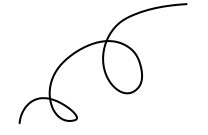


For companies in Sweden, Denmark, Norway and Finland, Germany is never far away. It is one of the region's largest trading partners, a key market for machinery, furniture, food, energy technology and design, and a gateway to the rest of continental Europe. Ferries, bridges and flights link the Nordics to Hamburg, Berlin and Munich every day.
Yet many Nordic exporters still approach German customers mainly in English. That works for a first meeting. It rarely works for building long-term business in Germany.
Why English is not enough in Germany
Nordic business culture is famously comfortable with English. Meetings in Stockholm or Copenhagen often switch to English without anyone noticing. Germany is different. Many German decision-makers speak good English, but purchasing departments, technical teams, works councils and end customers generally expect documentation in German.
Organisations such as Business Sweden and Germany Trade & Invest regularly point out that German buyers value detailed, precise information. A product sheet in English may be read. A product sheet in German is more likely to be trusted and forwarded internally.
What Nordic companies usually need to translate
- Websites, product catalogues and online shops
- Technical manuals, safety data and installation guides
- Tender documents and proposals for public buyers
- Contracts, terms and conditions and warranties
- Marketing materials, case studies and press releases
Some of these carry legal weight. Consumer information, product safety texts and contracts must be clear and correct in German. This is where professional german translation services make a real difference, combining native German linguists with knowledge of the relevant industry.
Different styles, different expectations
Nordic marketing is often understated, friendly and informal. Swedish and Danish companies like to speak to customers as equals, using first names and a relaxed tone. German business communication tends to be more formal, especially in B2B, and places great value on facts, specifications and certifications.
A translator working from Swedish or English into German therefore does more than swap words. They adjust tone, restructure sentences and add the detail German readers expect. The goal is to keep the brand personality while meeting local expectations.
A good German translation sounds like it was written in Germany, not imported from Scandinavia.
Beyond Germany, the rest of Europe
Germany is often the first step. Austria and German-speaking Switzerland follow naturally. Many Nordic exporters then look at France, Belgium and the French-speaking part of Switzerland. That brings another major language into the picture.
Professional french translation services ensure that French-speaking customers receive the same quality as German ones. Keeping terminology consistent across German, French and English versions is essential when the same product is sold in several markets.
Keeping multilingual content under control
With every new language, the amount of content grows. Product updates, price changes and new campaigns must be reflected everywhere. Without a system, companies end up with outdated German pages and inconsistent terms.
Translators increasingly work in a shared cat tool, where previous translations and approved terminology are stored and suggested automatically. For a Finnish machinery maker or a Danish design brand, that means German, French and English texts stay aligned even as the catalogue changes every season.
Official documents and certification
Companies that regularly submit paperwork to German authorities often look for certified translation services that understand both the language and the formal requirements. A certified translation carries a signed statement of accuracy, which courts, tax offices and commercial registers typically require before they accept a foreign document. Choosing a provider that handles certification in-house avoids delays caused by rejected paperwork. For Nordic exporters managing subsidiaries or staff relocations, that reliability is worth building into the process early.
Not every document is commercial. Nordic companies setting up a German subsidiary need company registration papers, board resolutions, powers of attorney and sometimes court or tax documents in German. Employees relocating to Germany need their certificates and diplomas recognised.
These documents often require certified or sworn translations. Requirements differ between authorities, so it is wise to confirm the exact format before ordering. A provider that handles both commercial and certified work can keep names, company details and terms consistent across all files.
Machine translation, helpful but limited
Machine translation between Scandinavian languages and German has improved considerably, helped by their shared Germanic roots. It is useful for understanding incoming emails and getting quick drafts. For customer-facing and legal content, human translation and review remain essential. German compound nouns, technical standards and legal terms leave little room for error.
Trade fairs as a turning point
For many Nordic firms, the first serious contact with German buyers happens at a trade fair in Hannover, Cologne, Düsseldorf or Munich. Visitors pick up brochures, scan QR codes and compare suppliers in a few minutes. A stand with German materials, a German landing page and staff ready with German product sheets makes a stronger impression than one relying on English alone. Preparing these materials months ahead, with proper translation and review, turns a busy fair into real leads.
Practical steps for Nordic exporters
- Start with the documents German buyers read before a first meeting.
- Create a German glossary of product and brand terms early.
- Use native German translators with industry experience.
- Adapt tone and detail level rather than translating word for word.
- Plan French and other languages with the same terminology base.
Why it pays off
Speaking German shows commitment to the German market. It reduces misunderstandings, speeds up purchasing decisions and builds the kind of trust that leads to repeat business. For Nordic companies used to operating internationally, investing in quality German content is one of the most effective ways to grow on the continent.
Recent Posts

Why Danish Business Translatio...
Schwedisch Übersetzer, was de...
Lo que un Traductor Sueco Espa...

Por Qué Hay Tan Pocos Traduct...
Cosa Distingue un Traduttore S...
Perché un Buon Traduttore Ita...
Share it.
Links
We use cookies
We use cookies to give you the best online experience, remember your preferences, and understand how the site is used. You can accept all cookies, reject optional ones, or choose which categories to allow.
Privacy PolicyCookie preferences
Choose which cookies we can use. Necessary cookies stay on because the site cannot work without them.
For more details, read our Privacy Policy.